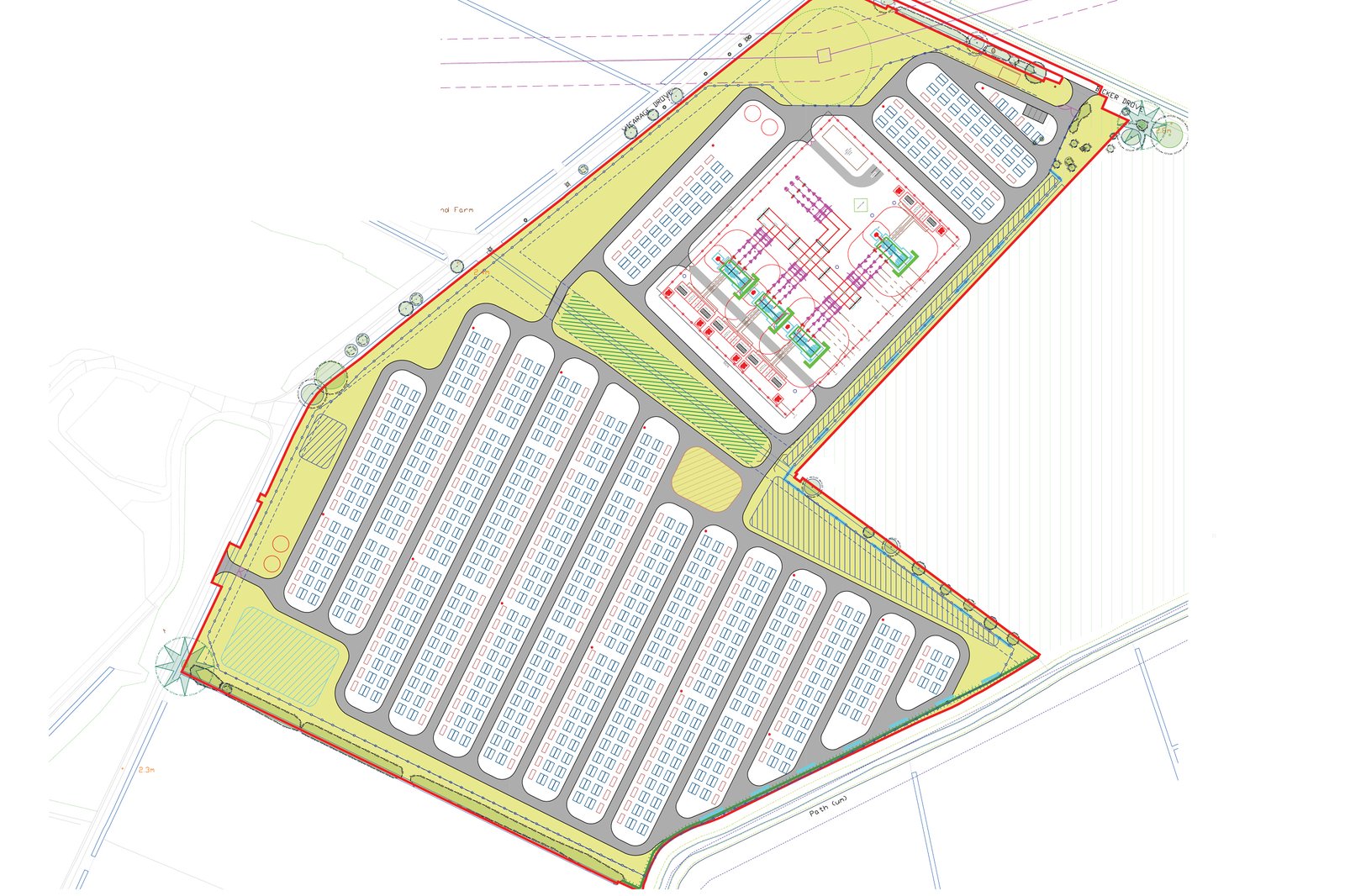
Boston Borough Council has approved plans for one of the UK’s largest Battery Energy Storage System (BESS) developments, granting planning permission for a major new energy storage facility on land east of Bicker Fen Substation.
The application, submitted by Bicker Drove Limited, sought permission for the installation and operation of a Battery Energy Storage System (BESS) together with associated infrastructure on agricultural land at Bicker Fen. The authority has now formally granted full planning permission, subject to an extensive list of planning conditions.
The approved development will provide a battery energy storage facility with an import and export capability of up to 1.2 gigawatts (GW), making it one of the largest projects of its type in the country. The scheme includes up to 1,056 battery storage units, a new 400kV air insulated substation, welfare facilities, security infrastructure, access roads, sustainable drainage systems and a dedicated biodiversity enhancement area covering around seven hectares.
The application was considered by Boston Borough Council’s Planning Committee after being called in by the local ward member to allow a full public discussion of the proposal. During the consultation process, the council received 32 letters of objection, with concerns raised over the loss of Grade 1 agricultural land, landscape impact, highway safety, fire risks, flooding, biodiversity and the cumulative effect of renewable energy developments in the Bicker Fen area.
Planning officers concluded, however, that national and local planning policy strongly supports renewable energy infrastructure and energy storage projects. Their report stated that battery storage is essential to increasing the capacity and flexibility of the electricity network, helping maximise renewable energy generation and supporting the UK’s transition towards net zero. Officers also determined that the site’s close proximity to Bicker Fen Substation made the countryside location necessary for the development.
A number of statutory consultees, including Lincolnshire County Council Highways, Environmental Health and Lincolnshire Fire and Rescue, raised no objections subject to conditions. Highway improvements, biodiversity measures, archaeological investigations, landscaping, drainage, construction management and fire safety strategies will all need to be delivered before and during development.
Among the planning conditions is a requirement that the Battery Energy Storage System must not exceed 1.2GW and that the development will have a 40-year operational lifespan. Once the facility reaches the end of its life, or if it ceases operating for an extended period, the developer will be required to decommission the site and restore the land in accordance with an approved restoration scheme.
The permission also secures long-term biodiversity enhancements, including new habitats, bird and bat boxes, amphibian and reptile mitigation measures, a 30-year habitat management plan and additional landscaping designed to soften the visual impact of the development.
The decision marks another significant addition to the growing concentration of renewable energy infrastructure around Bicker Fen, which already hosts major electricity transmission assets including the National Grid substation, Viking Link, Triton Knoll and several other approved battery storage and solar energy developments.