Major planning permission has been granted for the redevelopment of the former Boston United Jakemans Stadium site into a new NHS Community Diagnostic Centre, marking a significant milestone in the regeneration of one of the town’s most historic locations.
Boston Borough Council formally approved the scheme on Friday 9th January 2026, granting full planning permission for the demolition of the remaining stadium structures and the construction of a purpose-built Community Diagnostic Centre (CDC), together with a mobile diagnostics service park, new access arrangements, parking, landscaping and associated infrastructure at the York Street site .
The application was submitted by Bramhall Town Planning Limited on behalf of United Lincolnshire Teaching Hospitals NHS Trust and will see the transformation of the 1.5-hectare site that was home to Boston United for nearly 90 years. The Pilgrims first played at York Street in 1933, and the ground became synonymous with some of the club’s most memorable moments, from famous FA Cup runs to packed floodlit league fixtures. Since the club’s relocation to the Jakemans Community Stadium in 2020, the former ground has stood largely unused, its stands and floodlights a prominent reminder of its sporting past.
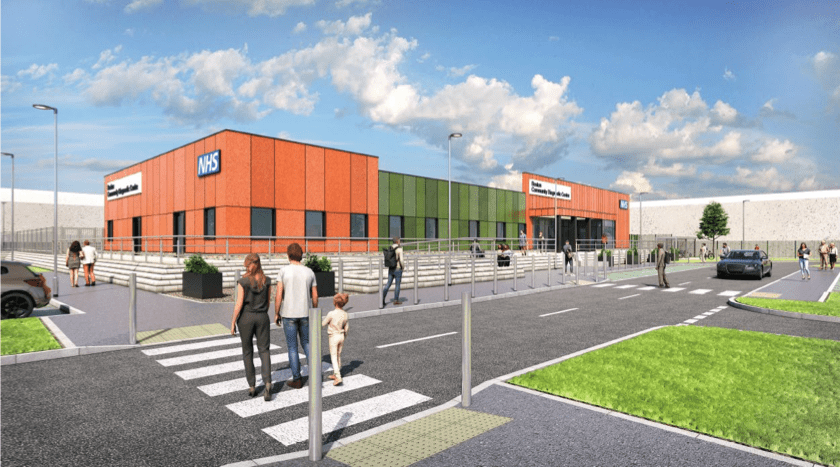
Under the approved plans, the site will be cleared and redeveloped with a single-storey, state-of-the-art diagnostic facility providing MRI, CT and X-ray scanning, consultation rooms and clinical assessment areas. The centre is expected to serve around 350 patients a day, enabling people to access vital tests closer to home, reducing waiting times and easing pressure on acute hospital services.
The development will bring significant investment into the heart of Boston and create around 45 full-time and 10 part-time jobs. The scheme includes 115 car parking spaces, electric vehicle charging points, cycle storage, improved pedestrian crossings and extensive landscaping designed to deliver a net gain in biodiversity. The building will be constructed using modern modular techniques and will incorporate renewable energy, including rooftop solar panels, with the aim of achieving a BREEAM “Excellent” sustainability rating.
The plans have also been shaped by the site’s sensitive surroundings, including the neighbouring Grade II listed Gilderdrome and Starlight Room. The approved design sets the new building further back than the former football stands and at a lower, single-storey height, improving the setting of the historic venue. As part of the planning decision, the Council also welcomed proposals for a permanent memorial to acknowledge the site’s footballing heritage, potentially including a marker to show the former centre spot and an information board celebrating the history of Boston United at York Street.
To mitigate the loss of the former playing pitch, the Trust has agreed to fund the delivery of a replacement football facility for Boston United Women’s team on land off Tattershall Road, secured through a legal planning agreement.
Daren Fradgley, Deputy Chief Executive and Chief Integration Officer at Lincolnshire Community and Hospitals NHS Group, said: “We are delighted to have secured full planning permission to build a community diagnostic centre in Boston. We are now working through the final arrangements, including completion of the purchase of the site, which will enable us to begin demolition and construction.
“This £24.9 million facility will bring additional much-needed diagnostic capacity to the town, helping the local community to access tests, such as X-rays, MRI, CT and audiology services, quicker and easier away from our very busy hospital sites.
“It will be run by the same NHS teams as our hospitals, with access to the same digital systems, and include its own dedicated free parking for patients.
“We hope to be ready to welcome our first patients in spring 2027.”
Richard Tice MP, Member of Parliament for Boston and Skegness, added: “This decision is hugely welcome news for Boston. Securing planning permission for a new Community Diagnostic Centre on the former York Street stadium site is a major step forward for local healthcare and for the regeneration of our town.
“This investment will mean faster access to vital scans and tests for local people, helping to diagnose illness earlier, reduce waiting times and take pressure off Pilgrim Hospital. It will also bring skilled jobs, modern infrastructure and renewed purpose to a site that holds enormous historical significance for our community.
“York Street was the spiritual home of Boston United for generations, and I am pleased that the Trust and the Council are committed to recognising and commemorating that proud sporting heritage as part of the redevelopment.
“This is exactly the kind of practical, forward-looking investment our area needs, improving health outcomes, creating opportunity and breathing new life into a landmark site at the heart of Boston.”
The decision notice confirms that the development must now proceed in accordance with a detailed set of conditions, covering matters such as construction management, protection of nearby heritage assets, flood resilience, highway improvements, landscaping and biodiversity enhancement .
With planning permission now in place, the project represents a major step towards transforming a long-derelict and historically important site into a modern healthcare facility, providing lasting benefits for residents while ensuring the legacy of York Street as the former home of Boston United is permanently recognised.