A major surface dressing programme has begun across the county
The Lincolnshire-wide scheme, one of the biggest ever undertaken and costing £6 million, is running from now until around the middle of June and will see a staggering 271 sites treated to stop potholes forming.
That’s around 188 miles of road that will get the road equivalent of creosoting a fence to protect the surface from bad weather and give another decade of use.
Set out in a straight line, those 188 miles are roughly the distance between Lincoln and Cardiff. Completed in around 10 weeks.
It’s a huge job with around 26,500 tonnes of aggregate used, supported by specialist plant, traffic management and the crews needed to deliver work at this scale. It is a significant commitment of funding and resources aimed at protecting the road network in a proactive way.
Surface dressing is a planned, preventative treatment applied to roads that remain structurally sound. By sealing the surface and restoring texture, it slows down wear, prevents water reaching the underlying layers and reduces the likelihood of potholes forming.The treatment also improves skid resistance, which is particularly important on rural routes where braking conditions can vary.
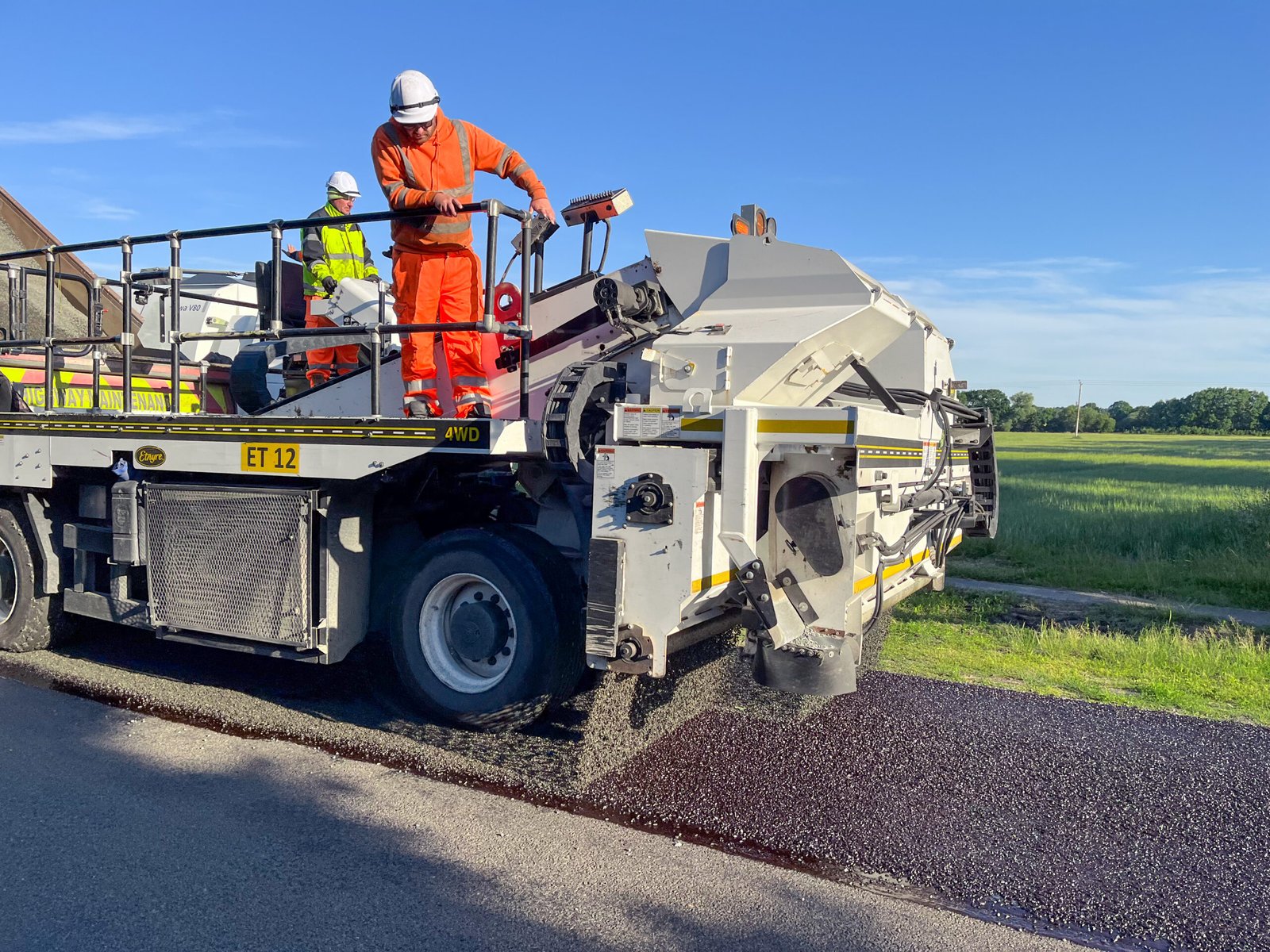
Ahead of the programme starting, road studs will be removed or repositioned where required. Ironwork such as gullies and manhole covers are masked to prevent the binder agent sticking to them. The ‘dressing’ process involves applying a controlled spray of bitumen, followed by one or two layers of aggregate stone chips depending on the condition of the road. The material is pressed down to ensure proper bonding which can meant that the surface might appear unfinished at first, but this is normal and it soon settles as traffic moves across it. A 20mph advisory speed limit will be in place at all sites to reduce the risk of loose chippings being displaced.
Sweeping of the loose material that’s not been compacted will take place within 24 to 48 hours of the treatment, with a second sweep happening 7 to 10 days later. A further sweep will be carried out after around 13 weeks after the work, too.
Selected locations will also receive what’s called an ‘encapsulation treatment’ to help secure the chippings and provide additional protection to the new surface. Road markings and studs will be reinstated within 28 days of completion.
Executive member for Highways at Lincolnshire County Council, Cllr David East said: “The scale of this year’s programme is massive and reflects the council’s commitment to maintaining the road network in an effective and cost-efficient way.
“The benefit of surface dressing like this is that it allows large areas to be treated quickly and at a fraction of the cost of full resurfacing. By using this approach over the coming weeks I hope that people on the roads treated can appreciate what we’re doing, and they can understand that this treatment is a great way to extend the life of a road before potholes set-in.
“I know that the early loose‑chipping stage is not always popular, but ask that everyone sticks to the 20mph limit where it’s necessary and the end result will be worth it.”
A live map showing daily work locations is available at www.lincolnshire.gov.uk/roadworks. Updates are made regularly, although timings may shift if weather conditions alter the schedule.
In our area, the following roads are set for treatment:
-
Southfield Lane – Fishtoft
-
Bull Pasture – Frieston
-
Bar Green Lane – Stickney
-
Common Road – Wrangle
-
Church End – Wrangle
-
Hampton Lane – Old Leake
-
Willows Lane – Sibsey
-
Chestnut Road – Boston
-
Middle Drove – Boston
-
Sherwood Avenue – Boston
-
Sheriff Way / Robin Hoods Walk – Boston
-
Robin Hood’s Walk – Boston
-
Fishtoft Road – Fishtoft
-
Church Green Road – Fishtoft
-
Kirton Drove – Amber Hill
-
Baythorpe – Swineshead
-
A52 Sleaford Road – Boston
-
B1397 Boston Road / London Road – Kirton
-
Main Road – Wigtoft
-
Hipper Lane – Wigtoft
-
Wigtoft Bank – Wigtoft
-
Five Bells Lane – Holfleet Stow
-
Fishmere End Road – Kirton
-
Church Lane – Algarkirk